By Kent Traders · Updated 24 October 2026 · 8 min read · England (Approved Document B)
A plumber drills a 110mm hole through a floor, drops a soil pipe through it and leaves a gap. That gap is a route for fire between flats. This guide covers fire stopping pipe penetrations in an HMO or hotel, using Approved Document B, and shows which Astroflame product suits which pipe.
Every opening for a pipe through a fire-separating element must be fire-stopped. Approved Document B gives three routes: a tested proprietary seal for any diameter, a small pipe with fire-stopping around it, or a metal sleeve up to 160mm. Unenclosed plastic pipes over 40mm need the seal or the sleeve.
What does fire stopping pipe penetrations involve?
Approved Document B says every joint, imperfect fit and opening for services through a fire-separating element should be sealed with fire-stopping. The aim is to keep the wall or floor's fire resistance intact. A pipe hole left open undoes the rating of the wall or floor it passes through.
The guidance applies in England under the Building Regulations 2010. Volume 1 covers dwellings, including flats. Volume 2 covers other buildings, such as hotels. Read Approved Document B on GOV.UK. For an existing property, ask your fire risk assessor which penetrations need attention.
The three routes in Approved Document B
The document sets out alternatives A, B and C, and you need only one of them for each pipe.
| Route | What it requires | Limit |
|---|---|---|
| A: proprietary seal | A tested system that maintains the fire resistance of the wall or floor | Any pipe diameter |
| B: restricted diameter | Fire-stop around the pipe, with the opening as small as possible | Pipe within the size in the table |
| C: sleeving | A high melting point metal sleeve, with fire-stopping around it | Up to 160mm, for five pipe materials |
A high melting point metal is one such as cast iron, copper or steel that will not soften or fracture to let flame or hot gas through at 800°C.
The sleeve route lists five pipe materials: lead, aluminium, aluminium alloy, fibre-cement and uPVC. Polypropylene, polyethylene and ABS are not listed, so those pipes use route A or B.
Pipe size limits: when a collar, wrap or sleeve is needed
Route B only works while the pipe stays within the size limit, and the limit depends on the material and where the pipe passes. The tables are Table 9.1 in Volume 1 and Table 10.1 in Volume 2.
| Situation | Metal (800°C) | uPVC, lead, aluminium, fibre-cement | Any other material |
|---|---|---|---|
| Volume 1: wall or floor between flats, pipe enclosed as in Diagram 9.1 | 160mm | 160mm stack, 110mm branch | 40mm |
| Volumes 1 and 2: any other situation, including unenclosed pipes | 160mm | 40mm | 40mm |
| Volumes 1 and 2: protected shaft that is not a stair or lift shaft | 160mm | 110mm | 40mm |
An enclosure only counts if it follows Diagram 9.1. It carries only drainage, water supply or vent pipes, has no access panel opening onto a circulation space or bedroom, and has a casing that is not sheet metal and has at least E 30 fire resistance.
An unenclosed plastic pipe over 40mm cannot use route B. It needs a tested proprietary seal, or a metal sleeve if it is uPVC.
Worked example: a four-flat HMO conversion
Take a house converted into four flats. The pipes and sizes are our assumptions. Check yours against the table.
| Pipe | Material | Route B limit | Result |
|---|---|---|---|
| 110mm soil stack, not enclosed | uPVC | 40mm | Over the limit: use route A or C |
| 110mm soil stack, enclosed per Diagram 9.1 | uPVC | 160mm stack | Route B possible |
| 32mm waste | uPVC | 40mm | Within the limit: route B |
| 22mm heating pipe | Copper | 160mm | Within the limit: route B |
| 50mm waste | Polypropylene | 40mm | Over the limit: route A |
Route B still needs a small opening and fire-stopping around the pipe. A tested product comes with a certificate.
A hotel is stricter. A 110mm uPVC pipe through a compartment floor falls under Table 10.1, "any other situation", which caps uPVC at 40mm. Use a tested seal or a sleeve.
Collar, wrap or sleeve: what Astroflame lists
Our wraps, collars and sleeves collection lists seven Astroflame products. The details below come from the product pages, and none of the four links a datasheet.
| Product | Pipe sizes | Rating on the page | Test standard on the page |
|---|---|---|---|
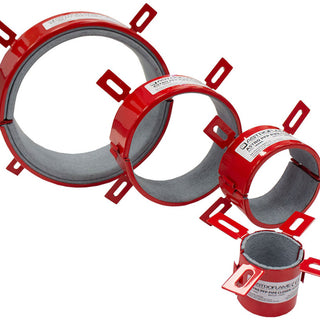
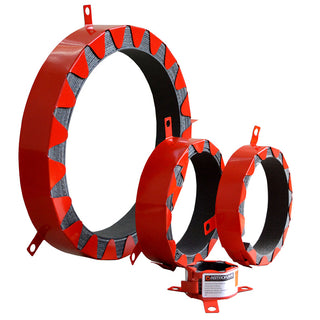
| Astro X Series CE pipe collar | 32mm to 250mm | EI120 and EI240 | EN 1366-3:2009 |
| Astroflame intumescent pipe closer | 32mm to 315mm | 4 hour | BS 476 Part 20 |
| Astroflame 4hr intumescent pipe wraps | 55mm to 315mm | Up to 4 hours | BS EN 13501 parts 1 and 2 |
| Astro CE thermal fire pipe sleeve | 17mm to 169mm | Up to EI120 in gypsum walls and solid floors, up to EI240 in solid walls | EN 1366-3 |
- Collar: supplied assembled in a mild steel case with three fixing tabs, for internal use. The page says to fit it at the soffit or on both faces of a wall, depending on the application.
- Pipe closer: designed for PVC pipes, and steel pipes for a cooling effect. It can sit on the surface or be recessed.
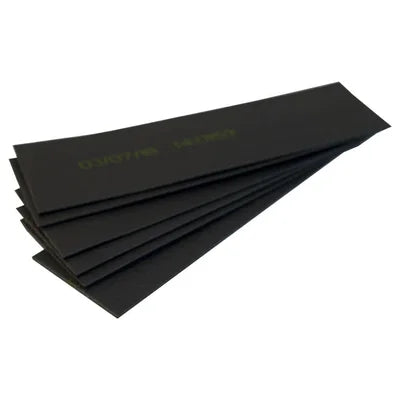
- Wrap: expands to 28 times its original size in a fire. It is listed for PE, PP, PVC, ABS and other plastics.
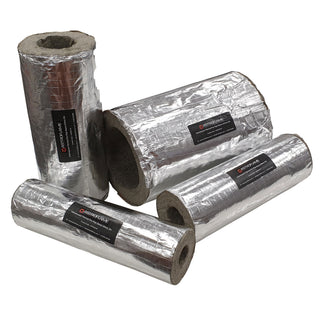
- Sleeve: 300mm long and 25mm nominal thickness. It can be cut along its length to retrofit, and one length can replace two collars.
Photograph each seal before the ceiling goes on. File the photo with the product name and certificate.
Gaps, joints and mastic around the pipe
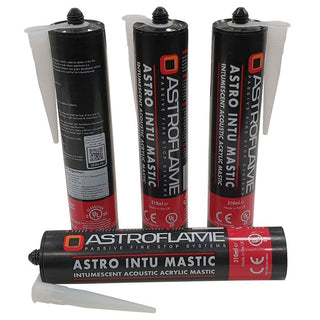
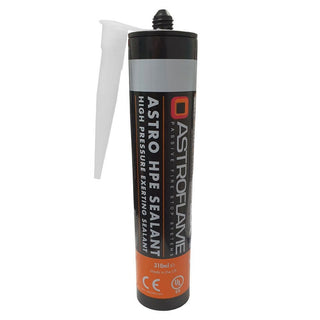
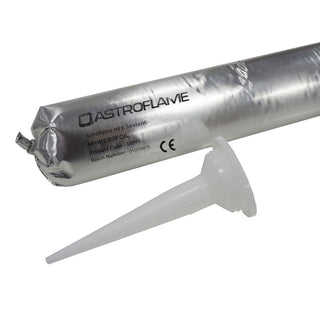
The gap around the pipe matters as much as the product. Approved Document B wants openings for pipes, ducts, conduits and cables to be as few as possible, as small as practicable and fire-stopped, allowing thermal movement for a pipe. Our fire rated mastic and foams cover the gaps.
Fire-stopping material needs support from A2-s3, d2 or better material where the unsupported span exceeds 100mm, or where it is non-rigid. The listed materials include cement mortar, gypsum plaster, ceramic products and intumescent mastics. Not every one suits every situation.
The document points to Association for Specialist Fire Protection guidance. See the ASFP technical documents.
Where pipe fire stopping goes wrong
- Leaving a visible gap between the pipe and the hole.
- Cutting a hole far larger than the pipe.
- Fitting a collar on one face when the certificate calls for both.
- Using a product on a pipe material or wall type its certificate does not cover.
- Relying on general mastic for a large plastic pipe.
- Closing the ceiling before recording the seal.
What to buy: Astroflame fire stop products
Prices are inc VAT and show the "from" price on each page, checked on 24 October 2026. The price depends on the pipe size you pick. All were in stock.
| Product | Sizes | From | Stock |
|---|---|---|---|
| Astroflame intumescent pipe closer | 32mm to 315mm, 14 sizes | £6.67 | In stock |
| Astro X Series CE pipe collar | 32mm to 250mm, 13 sizes | £8.11 | In stock |
| Astroflame 4hr intumescent pipe wraps | 55mm to 315mm | £2.87 | In stock |
| Astro CE thermal fire pipe sleeve | 17mm to 169mm, 19 sizes | £29.02 | In stock |
For the wider range, see the Astroflame collection. Three of the four pages say the item ships direct from the supplier in three to five working days. The pipe closer page confirms dispatch at order.
Before you order, confirm the pipe material and size, the wall or floor construction, the fire rating you need and the certificate for the exact product and size.
FAQs
No. Approved Document B applies to pipes passing through a fire-separating element, such as a compartment wall or floor, unless the pipe is in a protected shaft. Ordinary partitions are not covered. Ask your fire risk assessor or building control which elements in your building are fire-separating.
On the Astroflame pages, the X Series collar is supplied assembled in a mild steel case with three fixing tabs. The wrap is an intumescent product that expands to 28 times its size on contact with fire. Both are tested systems, so follow the certificate for fitting.
Approved Document B lists intumescent mastics among fire-stopping materials but warns that not every material suits every situation. Plastic pipes melt in a fire, so the guidance routes are a tested sealing system, a pipe within the size limit, or a metal sleeve. Check what the mastic certificate covers.
It depends on the pipe material and location. Metal pipes that stay intact at 800°C can be up to 160mm. A uPVC pipe is limited to 40mm unless it is an enclosed stack or branch in a qualifying situation. Other plastics such as polypropylene are limited to 40mm.
No. GOV.UK states that Approved Document B applies to England. Scotland, Wales and Northern Ireland have their own building standards and guidance, so check the rules for the nation where your property sits before specifying products or signing off work.
The product pages we checked refer to the test certification but do not link a datasheet. Ask the supplier for the certificate before you specify the product, and check that it covers your pipe material, size and wall or floor construction.
Related reading
Seal every opening, keep every certificate
Match each pipe to a tested product and record the work. Trade buyers can open an account for repeat orders.
Shop wraps, collars and sleevesOpen a trade account