Picture a guest woken at 2am by a sounding alarm in a room they have slept in once. The power is off, the curtains are drawn and the door is somewhere to the left. Whether they find it quickly depends on a decision the owner made months earlier, usually without realising it was a fire safety decision at all.
Home Office guidance lets the smallest guest premises in England rely on rechargeable torches in each bedroom instead of fixed escape lighting, but only torches that light automatically when the mains fails, with a sign explaining them. A battery torch that lights when lifted helps guests, but it is not the same thing. Larger premises need proper emergency fittings.
What Does the Guidance Actually Say About Torches?
The Home Office guide Making your small paying guest accommodation safe from fire (updated January 2025) is the document most small B&B, guest house and holiday let owners in England are measured against. It is issued under Article 50 of the Regulatory Reform (Fire Safety) Order 2005, which means a court can treat following it, or ignoring it, as evidence of whether you met your legal duty.
On escape lighting it sets out a clear order of thinking:
- First, borrowed light. Would street lighting or similar be enough for a guest to find the way out if a fire cut the power? With curtains drawn and an unfamiliar layout, often not.
- If not, emergency escape lights. Battery-backed fittings on hallways, stairs and other routes guests would have to use in the dark.
- In the smallest premises only, rechargeable torches that come on automatically if the supply fails may be acceptable instead, one in each bedroom, with a sign explaining what they are for.
The word that matters is "may". Article 50 guidance uses "must" for legal requirements, "should" for recommendations and "may" for permission. The torch route is a permission for low-risk buildings, not a default for everyone, and your fire risk assessment is what decides whether it applies.
Who counts as "small": the guide covers premises with a simple layout on the ground floor, or ground and first floor, sleeping no more than 10 people with no more than four first-floor bedrooms, plus individual flats. Anything bigger or more complex should be assessed against the separate sleeping accommodation guide instead.
Not Every "Emergency Torch" Does the Same Job
This is where buyers get caught out. Hospitality torches are sold under similar names but behave very differently when the lights go off, and only one type matches what the guidance describes.
| Option | What happens in a power cut | Where it fits |
|---|---|---|
| Rechargeable torch that lights automatically on mains failure | Comes on by itself in its charging base, then lifts out as a torch | The type the small premises guidance describes for bedrooms |
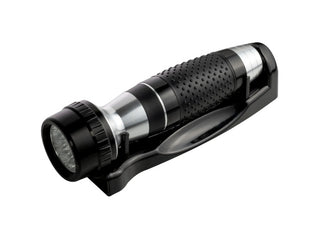
| Wall-mounted battery torch that lights when lifted (e.g. Corby Brighton) | Stays dark until a guest finds it and lifts it off the holder | Guest reassurance and power cuts; not a substitute for escape lighting |
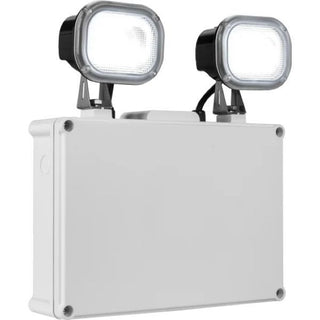
| Self-contained emergency fitting (bulkhead or twinspot) | Switches on automatically and lights the route for its rated duration | Hallways, stairs and exits; the standard answer beyond the smallest premises |
The Corby Brighton LED Emergency Torch is a good product for what it is: it runs on three supplied AAA batteries, mounts on the wall, has an anti-theft design and switches on as soon as it is removed from its holder. That makes it easy for a guest to grab in the dark. What it does not do is light up on its own when the power fails, so if your risk assessment is relying on bedroom torches in place of escape lighting, check that the model you fit actually does what the guidance says.
When a Torch Stops Being Enough
Most guest houses above the small premises threshold, and practically every hotel, will need fixed emergency escape lighting on corridors, stairs and at final exits, designed to BS 5266-1 emergency lighting guidance. Premises with sleeping accommodation commonly specify a three-hour duration because guests may be asleep and evacuation takes longer.
We covered the same principles for shared houses in our HMO emergency lighting guide. The logic carries straight across to guest accommodation: the risk assessment decides whether you need it, BS 5266-1 decides how it performs, and a competent electrician designs and installs it.
Trade Note: a non-maintained twinspot such as the Luceco Tempus LEMIPTWNM3 (IP65, three-hour duration, adjustable heads) suits an entrance hall, stairwell or external exit where one fitting needs to throw light in two directions. The guidance also suggests considering external lighting so guests can move safely away from the building once outside.
Where the Bedside Torch Still Earns Its Place
None of this makes a bedroom torch pointless. Most power cuts have nothing to do with fire, and a guest who can find a torch on the wall is far less likely to stumble around an unfamiliar room, trip on a luggage rack or call reception in a panic. That is why a bedside torch sits on our printable hotel room setup checklist alongside the kettle, hairdryer and safe.
A few practical points make it work properly:
- Mount it where a guest will look. Beside the bed or just inside the door, at a consistent height in every room, so housekeeping and guests both know where it lives.
- Check it at changeover. The guidance recommends a monthly functional test of rechargeable torches and emergency lights, and a test at each change of occupancy where no staff are on site. Add battery checks to the housekeeping list.
- Tell guests it is there. A line in the welcome pack, next to the escape route and fire action notice, costs nothing.
Frequently Asked Questions
Get the Torch and the Escape Route Right
Corby guest room torches, Luceco emergency twinspots and the full hospitality range, trade priced for multi-room orders.
Browse Guest Room Torches →