An HMO inspection does not care that your smoke alarms are new. If the escape route goes dark the moment the power cuts out, you fail on the spot.
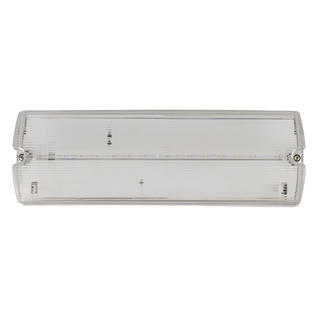
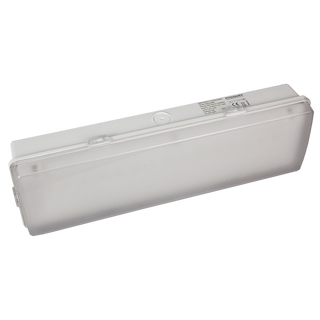
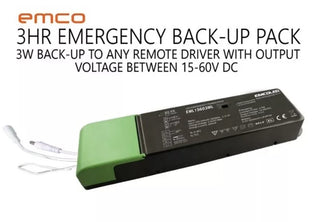
Most licensed HMOs need emergency lighting on escape routes under BS 5266-1, covering communal stairs, hallways and final exit doors so residents can get out safely if the mains supply fails. Self-contained, non-maintained LED fittings such as Emco's EML series give 3 hours of battery backup and satisfy most local authority licensing conditions.
Does Every HMO Actually Need Emergency Lighting?
Not every HMO is legally required to fit it, but most licensed ones end up needing it in practice. The Regulatory Reform (Fire Safety) Order 2005 puts the duty on the "responsible person" to carry out a fire risk assessment, and its emergency route provisions require escape routes to be lit sufficiently for people to leave safely. In a small house with natural light on every landing, a risk assessor might accept normal lighting is enough. In anything with internal corridors, basement rooms or more than two storeys of shared circulation, that assessment is almost always going to call for dedicated emergency lighting.
Where BS 5266-1 comes in is specifying how that lighting should perform once the assessment says you need it: illumination levels along the escape route, minimum duration, and how quickly it activates after mains failure. Most council licensing officers now treat BS 5266-1 compliance as the baseline evidence they want to see, rather than accepting a generic risk assessment on its own.
Where Emergency Lighting Is Actually Required in an HMO
The pattern that comes up again and again on refurb jobs, using a converted 6-bed HMO in Leeds as a working example:
| Location | Typical fitting | Minimum duration |
|---|---|---|
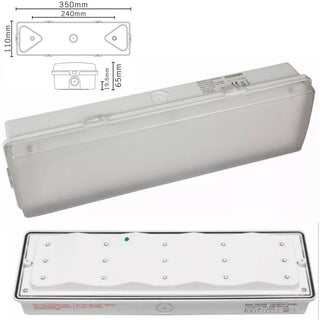
| Communal stairwell | Self-contained non-maintained LED bulkhead or twin-spot | 3 hours |
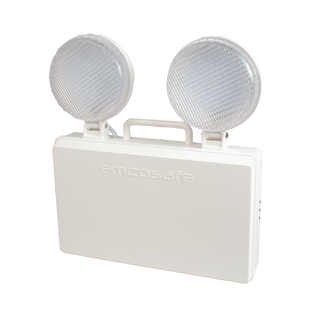
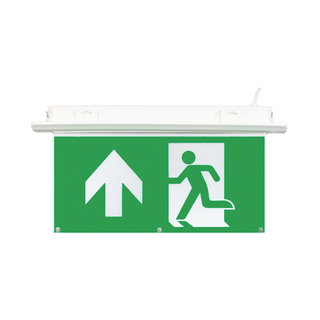
| Final exit / front door | Non-maintained twin-spot above the door | 3 hours |
| Internal corridor with no window | Non-maintained bulkhead every 30-45m or at each change of direction | 3 hours |
| Kitchen or shared living room used as part of the escape route | Non-maintained fitting near the exit door | 3 hours |
| Fire door with self-closer | Fire-rated downlight or bulkhead nearby, if the door sits on the route | 3 hours |
If you are refitting a whole HMO rather than just the escape route, it is worth reviewing the wider hotel and HMO supplies range at the same time, and checking existing landing and stairwell fittings against the general lighting collection for anything overdue a swap.
Maintained vs Non-Maintained: Which Do You Actually Need?
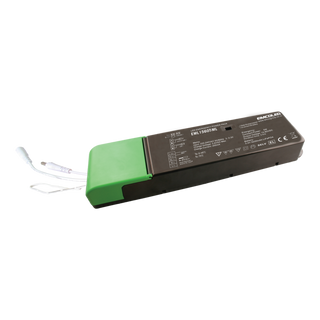
For almost every HMO, non-maintained is the right call, and it is not close. A non-maintained fitting like the Emco EML15605ML sits dark until the mains supply drops, then switches to battery automatically. A maintained fitting stays permanently lit, mains or battery, which is really built for spaces like cinemas or exhibition halls where you want constant illumination regardless of power state.
Running maintained fittings in a residential HMO just burns through the battery unnecessarily and adds a running cost for no compliance benefit. Unless a fire risk assessor has specifically asked for maintained lighting in one particular area, non-maintained is what most licensing officers expect to see and what most trade buyers actually fit.
Sorting a whole HMO in one go? The Emco range covers bulkheads, twin-spots and fire-rated downlights with matching 3-hour backup, so you are not mixing brands across one escape route.
Shop Emco Emergency Lighting →What Happens If You Get Caught Without It
A basic non-maintained twin-spot fitting runs somewhere around £15-£25 trade, and a 6-bed HMO typically needs four to six fittings to cover the stairwell, corridors and final exit, so you are usually looking at under £150 in fittings for a full retrofit plus an electrician's time to wire them into a fused spur.
Set that against the actual cost of failing: a licensing officer can refuse to renew an HMO licence, issue an improvement notice with a compliance deadline, or in more serious cases refer the property under the Housing Act 2004. A refused renewal on a licensable HMO means the landlord is operating unlicensed, which carries an unlimited fine under section 72 of the Housing Act 2004. £150 in LED fittings is not a close call against that.
Testing and Keeping Records
Fit-and-forget does not hold up at renewal. Keep a simple log: date of the monthly key-test, date of the annual 3-hour discharge test, and who carried it out. Emco's EML panel range has a visible LED indicator so a monthly test takes about thirty seconds per fitting, walking the escape route with the test key.
If you manage more than one HMO, put the annual discharge test on the same rolling schedule as your gas safety and EICR checks. Licensing officers respond well to a landlord who can produce one consistent compliance file rather than scattered paperwork found the week before an inspection.
Frequently Asked Questions
Don't Let Lighting Be the Reason Your Licence Gets Refused
Emco's emergency range covers bulkheads, twin-spots and fire-rated downlights, all built to BS 5266-1 with 3-hour backup.
Shop Emco Emergency Lighting →