BS 6465 HMO Bathrooms: How Many Do You Need? | Kent Traders

Fail an HMO inspection over bathroom numbers and the council won't care how good your wiring is.

Quick Answer

Most councils expect at least one bathroom, meaning a WC, basin and bath or shower, per 5 sharers in an HMO, based on BS 6465-1:2006+A1:2009 provision tables. Larger properties usually need two bathrooms minimum. Always check your specific local authority's amenity standard before fitting out, as exact ratios vary by council and property type.

Browse HMO Bathroom Fittings at Trade Prices →

How Many Bathrooms Does Your HMO Actually Need?

There's no single national number written into law for this. BS 6465-1:2006+A1:2009 sets out the sanitary provision tables that most council HMO amenity standards are built on, but each local authority publishes its own version with its own thresholds. The pattern is consistent though: one bathroom covers a handful of sharers, and the requirement steps up as occupancy rises.

We've priced fittings for 6-bed HMO conversions in Selly Oak, Birmingham, where the council's amenity standard table is noticeably stricter than the BS 6465 baseline figure. Don't assume your council matches the textbook number. Phone the private housing or licensing team before you order a single pan.

Sharers Minimum WCs Minimum Bathrooms (bath or shower)
3 to 4 1 1
5 to 6 1 1
7 to 8 2 2
9+ 2 2, plus 1 more per extra 4 sharers

These figures are typical of BS 6465-derived council standards, not a single fixed national rule. Confirm the exact table with your local authority before committing to a layout.


What Actually Counts as a "Bathroom" for Licensing?

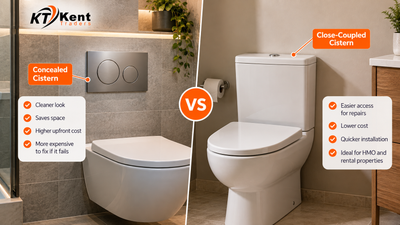
A WC and a wash basin together is the bare minimum for sanitary accommodation. A full bathroom needs a bath or shower as well. En-suite conversions count towards the ratio provided they have their own WC and basin, which is exactly why concealed cistern frames have become the default for tight HMO bedroom layouts. A Geberit Duofix concealed cistern frame sits inside the stud wall instead of behind a bulky back-to-wall pan, which is often the difference between fitting a compliant en-suite and not fitting one at all.

Trade Note: A WC without a wash basin doesn't satisfy most council amenity standards on its own. Always spec the pair.

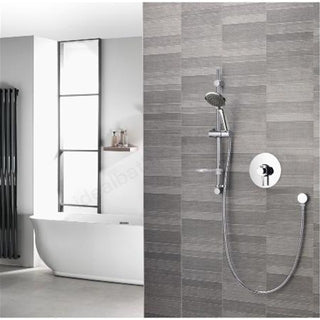
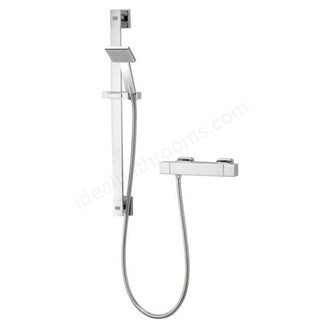
Grohe or Aqualisa: Which Shower Survives Shared-House Use?

In an HMO, every shower gets used by more people, more often, with less care than in a single-family home. Durability matters more than the finish on the handset.

£90 to £140 trade ex VAT

Thermostatic mixer with an anti-scald shut-off and a ceramic cartridge that holds up well to heavy daily use. Spares are easy to source years after install, which matters when you're managing a portfolio rather than one bathroom.

£280 to £420 trade ex VAT

Digital control suits tenants who don't get on with a thermostatic mixer dial, and the temperature memory is genuinely useful in a shared house. The processor box is a second component that can fail, and it costs more to replace than a Grohe cartridge.

For a tight refurb budget, the Grohtherm wins on cost and serviceability. The Aqualisa earns its premium where you're chasing a higher-spec let and tenants who'll actually use the digital control.

Speccing a multi-room conversion? Get bathroom fittings priced and delivered in phases as each flat completes.

Get a Phased Delivery Quote →

Getting the Paperwork Right Before the Inspector Does

HHSRS assessors and licensing officers check bathroom provision against occupancy on the application form, not against what's nice to have. Keep photographic evidence of every WC, basin and bath fitted, plus a simple floor plan showing room-to-bathroom ratios, ready for licence renewal.

Budget roughly £450 to £650 trade ex VAT per compliant en-suite, covering an Ideal Standard WC and basin set plus a Geberit frame but excluding the shower itself. That's usually enough to get through a council inspection without scrambling at renewal time. Cross-check your council's current published standard against gov.uk's HMO licensing guidance before you order, and the underlying provision tables in BS 6465-1:2006+A1:2009 if your council's table leaves a gap unanswered.

If you're refitting the rest of a hospitality or HMO room at the same time, our Corby of Windsor hotel kettle buying guide covers the small appliances side of the same refurb.

Frequently Asked Questions

Most councils expect at least one full bathroom, meaning a WC, basin and bath or shower, for up to 5 sharers under BS 6465-derived standards. Above 5, expect to need two. Always confirm with your specific local authority, as published ratios differ between councils.
BS 6465-1:2006+A1:2009 sets out general sanitary provision tables that most council HMO amenity standards are based on, rather than being a law written specifically for HMOs. Local licensing conditions are what you're actually assessed against, so check the council's own published table.
Yes, sharing is normal in HMOs and is exactly what the provision ratios are designed for. The issue is sharing beyond the ratio your council allows, which is when licence applications get queried or refused.
Yes, provided it has its own WC and wash basin and isn't just a shower cubicle bolted into a bedroom. A Geberit concealed cistern frame is the usual way to fit a compliant en-suite into a small HMO bedroom without losing too much floor space.
There's no single fixed national ratio. Most councils work from BS 6465-derived tables starting around one WC per 5 sharers, tightening as occupancy rises. Treat any ratio you read online as a starting point, not a guarantee, and confirm with your local authority.
Ideal Standard's Concept and i.life ranges keep the pan and basin cost down for straightforward back-to-wall layouts. Geberit earns its higher price in tight en-suite conversions, where the concealed cistern frame is often the only way to fit a compliant WC into the available depth.

Get Your HMO Refurb Bathroom Fittings Sorted

Trade pricing on Geberit, Ideal Standard, Grohe and Aqualisa, with phased delivery as each room completes.

Get a Trade Quote →


Previous articleAstroflame Fire Stop Kits for HMO Fire Doors | Kent Traders All articles Next articleHotel Entrance Matting: What the Law Requires | Kent Traders

RELATED ARTICLES

Standard letterbox
Why a Standard Letterbox Voids Your Fire Door Rating | KT

A standard letterbox cut into an FD30 fire door is one of the most commonly missed compliance failures on a fire door inspection, and...

Closed vs concealed cistern
Concealed vs Close-Coupled Cisterns: Which for HMO? | KT

Landlords specifying cisterns for an HMO refurb usually pick on looks alone, and that's exactly where it goes wrong. A concealed cistern behind a...

Downlight insulation
Loft Insulation Over Downlights: What Actually Stops Fires

A landlord had fire-rated downlights fitted throughout an HMO loft conversion, then two years later a contractor topping up the loft insulation buried every...

Hotel welcome trays
Hotel Welcome Trays: What Actually Needs PAT Testing | KT

A guest complained her room kettle kept tripping the socket, and maintenance found the element had been failing for weeks. Nobody had tested it...

illuminated mirror and shaver stock
Illuminated Mirrors & Shaver Sockets: What's Legal | KT

A landlord asked an electrician to wire a normal double socket behind an HMO bathroom's new illuminated mirror, and was refused on the spot....

Garden room electrics
Garden Room Electrics: What Cable Actually Goes In | KT

A homeowner ran a heavy-duty extension lead across the lawn to a new garden office, and it tripped the whole house's RCD every time...

Masterplug night light sockets
Night Light Sockets: Do You Need One or a Lamp? | KT

A homeowner upgraded from a 7kW to a 10.5kW shower and kept the existing 6mm cable, assuming a cable is a cable. Within weeks...

USB DESKTOP POWER OUTLET
Reception Desk Power & USB Charging: What to Spec | KT

A guesthouse fitted USB sockets throughout every guest room but left reception on its original two sockets, both already taken by the card machine...

Hotel coffee pod machines
Hotel Kettle or Pod Machine? What Guest Rooms Need | KT

A guesthouse swapped every room kettle for a pod machine and found the sachet-restocking bill roughly doubled while some guests complained they couldn't make...

stairwell and corridor lighting
Corridor & Stairwell Sensor Lighting Guide | Kent Traders

A guesthouse stairwell had a switch only at the bottom, and a guest missed the last two steps coming down in the dark. PIR-controlled...

School Classroom Uk
School & Classroom Electrical Spec Guide | Kent Traders

A primary school fitted standard white moulded sockets along classroom skirting and was replacing cracked faceplates within a term. Schools take more physical abuse...

Extractor fan rates
Extractor Fan Ratings: Litres/Sec by Room | Kent Traders

A landlord replaced a failed bathroom extractor fan with whatever unit looked closest to the old one, and the property still failed its damp...

GU10, B22 or E27? UK Lamp Fittings Explained | KT

A guest ordered ten replacement bulbs for a downlight and every one arrived with the wrong base, because the old bulb wasn't a GU10,...

LD1, LD2 or LD3 Fire Alarms for HMOs? | Kent Traders

A landlord fitted LD3 smoke alarms and still failed his council's HMO licence inspection, because a shared house needs LD1 or LD2 coverage under...

Taps for Low Water Pressure: What to Buy | Kent Traders

A brand new tap that only dribbles is almost never faulty. It is a pressure mismatch. Every tap has a minimum operating pressure in...

Selective Licensing
Selective Licensing Is Expanding Fast: Are You Covered? | KT

A landlord with an ordinary single-family let, no HMO, no lodgers, found his street had quietly fallen inside an expanded selective licensing zone. A...

Shop products from this guide

Shop the products in this guide

View all