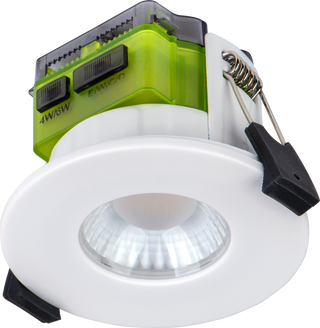
A landlord converting a house into two flats fitted twelve ordinary downlights into the new separating ceiling. Every single one needed replacing before building control would sign it off.
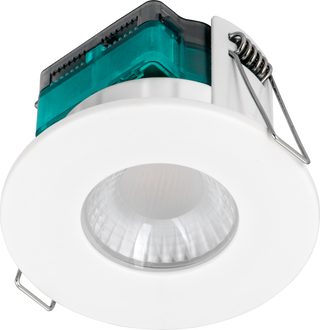
A fire-rated downlight maintains the fire resistance of the ceiling it's cut into, typically for 30 to 90 minutes, which matters wherever that ceiling separates two dwellings, flats, or a room from a loft space. A standard downlight leaves a hole in that fire barrier. Luceco's F-Type Essence and FType Mk2 ranges are IP65 and fire-rated, tested and specified for exactly this use.
Why Does a Downlight Need to Be "Fire-Rated" at All?
A ceiling or floor between two separate dwellings, or between a room and a loft, is a fire compartment boundary. Building regulations require that boundary to resist fire spread for a defined period, and cutting an ordinary downlight hole through it defeats that entirely, whatever the plasterboard itself is rated for. A fire-rated downlight is built with an intumescent element or a fire hood that expands under heat and seals the gap, so the compartment line stays intact even with a light fitting cut into it.
This is not a theoretical distinction. Approved Document B, the fire safety part of the Building Regulations, expects compartmentation between flats and between a habitable room and a roof space to be maintained. A converted HMO in Sheffield with downlights cut through the ceiling between two let flats is exactly the scenario building control checks first on an inspection.
Where Fire-Rated Is Not Optional
| Location | Fire-rated required? |
|---|---|
| Ceiling between two separate flats or HMO lets | Yes, always |
| Ceiling below a loft or roof space | Yes, if the loft is not otherwise fire-separated |
| Ceiling below an occupied first floor in a single dwelling | Recommended, not always mandatory depending on layout |
| Ground floor ceiling with no habitable space above | Not required on fire-compartment grounds |
Our honest take: on any conversion or HMO job, specify fire-rated as standard rather than checking case by case. The price difference is small and the cost of an inspector finding a single non-rated downlight in the wrong ceiling is a full re-fit of that room.
F-Type Essence vs FType Mk2: Which Luceco Range Fits the Job
Trade-rated fixed colour temperature options at 3000K or 4000K. The straightforward choice for a standard fire-rated ceiling job where speed of install matters, with a tooless connector that cuts fitting time on multi-unit jobs.
One fitting covers four colour temperatures and two power outputs via a selector, useful where a single SKU needs to serve rooms with different lighting briefs, or where the electrician wants fewer variants on the van.
Specifying a whole-property lighting fit-out? Fire-rated downlights sit alongside our full trade Luceco range.
See the Full Lighting Range →Fitting Fire-Rated Downlights: What to Check First
Cut-out diameter and minimum ceiling void depth vary by model, so confirm the fitting matches the joist depth available before ordering in bulk. This remains notifiable electrical work under Part P of the Building Regulations wherever a new lighting circuit is involved, separate from the fire-rating question itself, which sits under Part B.
Price reality check: a fire-rated GU10 downlight typically costs a few pounds more per unit than a non-rated equivalent, which on a twelve-downlight room adds up to a modest total against the cost of an inspector rejecting the ceiling and requiring a full re-fit.
Don't Let a Downlight Fail the Fire Inspection
Luceco fire-rated IP65 downlights, trade priced, in stock now.
Shop Fire-Rated Downlights →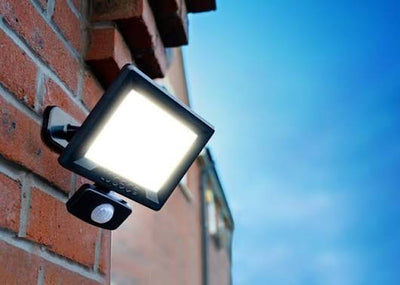

![Luceco Solar Guardian PIR Floodlight Black, IP65 Rated, 10 Watts [Energy Class A] by Luceco (luceco-LEXSF11B40-Shopify-01)](http://kenttraders.co.uk/cdn/shop/files/1da24b2a-057b-413e-8ba9-f073ab293e08.jpg?v=1683931766&width=320)