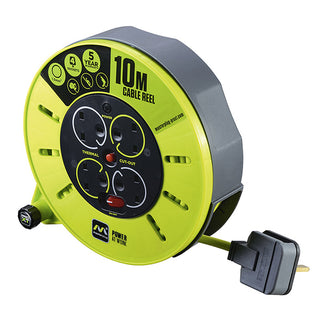
A homeowner ran a heavy-duty extension lead from the kitchen to a new garden office, coiled loosely across the lawn under a bit of decking board. It worked, until the first heavy rain, when the lead tripped the whole house's RCD every time it rained hard enough to pool water near the cable run.
A garden room needs its own buried supply, not an extension lead. SWA cable runs from the house consumer unit to a sub-consumer unit inside the garden building, and from there it's wired like any other room. This is notifiable work under Part P, and should be designed and certified by a qualified electrician.
Why an Extension Lead Isn't a Real Solution
An extension lead run across a garden, even a heavy-duty one, is exposed to exactly the conditions it isn't built for: standing water, UV degradation, being run over, or being caught by a strimmer. It's also drawing the garden building's entire load through a single flexible cord rated for a fraction of what a proper circuit can carry, which is why extension-lead-powered garden offices so often trip when more than one appliance runs at once.
The correct approach treats the garden building as what it is: a separate structure that needs its own properly designed electrical supply, buried and protected the same way any permanent underground cable run would be. The IET's own Part P guidance confirms outbuildings such as garages and sheds, and new circuits to them, fall squarely within notifiable work.
| Component | What it does |
|---|---|
| SWA cable (buried run) | Carries the supply from the house consumer unit to the garden building, steel armour gives mechanical protection and doubles as the earth conductor |
| Sub-consumer unit | A small fuseboard inside the garden room with its own RCD and MCBs, the point where SWA hands over to normal twin and earth |
| Internal wiring | Standard twin and earth from the sub-consumer unit to sockets and lights, exactly as in any other room |
| Trench depth | Typically around 600mm, deep enough to sit below ordinary gardening activity |
This is notifiable work. Running a new circuit to an outbuilding falls under Part P of the Building Regulations in England and Wales. Either use an electrician registered with a competent person scheme who can self-certify, or notify local building control before work starts. Either route needs to end with a completion certificate.
Sizing the Cable to the Actual Load
Cable size for a garden building depends on the load and the run length, not a single fixed answer. A small shed with lights and one socket circuit typically needs a smaller cable than a garden office running a computer, monitor, heater and lighting simultaneously, and a longer run generally needs a larger cable to keep voltage drop within limits even at the same load.
It's worth planning for slightly more capacity than the current use needs. A garden office is commonly extended later with air conditioning, extra sockets, or a second workstation, and a consumer unit with spare capacity built in from the start avoids a second dig later.
Frequently Asked Questions
Power the Garden Room Properly, Not With a Shortcut
Outdoor and weatherproof electrical supplies, trade priced and in stock now.
Browse Outdoor Sockets →