By Kent Traders Team · Updated 13 Oct 2026 · 6 min read · England
The electric shower kW rating decides how much cold mains water the unit can warm, not how hot the shower feels. Pick too small and winter showers run weak. Pick too big and you may need a bigger breaker. For most homes, 9.5kW is the sensible default.
Quick answer: Choose 9.5kW for most homes. It gives about 3.9 litres a minute at 37 degrees from 5 degree winter water on a 40A circuit, per the Aqualisa eVolve datasheet. Pick 10.5kW for a stronger winter flow if the board can take a 45 or 50A breaker, and 8.5kW only where supply is limited.
Which electric shower kW rating do you need?
Choose 9.5kW for most homes, 10.5kW where the mains water is cold and the flow is generous, and 8.5kW only where the electrical supply cannot take more. The kW figure is heating power. It decides how much water the unit can warm, not how hot the shower feels.
| Rating | Current at 240V | MCB (Aqualisa datasheet) | Price from (13 Oct 2026) |
|---|---|---|---|
| 8.5kW | about 35A | 40A | £310.38 |
| 9.5kW | about 40A | 40A | £321.54 |
| 10.5kW | about 44A | 45 to 50A | £332.69 |
Those are Aqualisa eVolve units in white and satin silver on the electric showers page. Current is power divided by voltage, so it is our sum rather than a datasheet figure. The cost of moving from 8.5kW to 10.5kW is £22.31 on the unit, but the circuit has to carry it.
Why a higher kW rating does not always mean a hotter shower
A shower is a heater that warms a stream of water, so power, flow and temperature rise are locked together. Each litre per minute needs about 4.19kW to warm it by 60 degrees, and the useful rule is: temperature rise equals roughly 14.3 times the kW, divided by the flow in litres per minute.
A 9.5kW unit at 4 litres a minute could lift the water by about 34 degrees in theory. At 6 litres a minute it manages only about 23. The same shower feels hot or lukewarm purely because of the flow.
Trade tip: When a customer says the shower is not hot enough, ask about the season before you ask about the unit. Winter mains water can be 10 degrees colder than summer, which costs the unit a third of its headroom.
How much water can each eVolve heat?
Aqualisa publishes maximum flow rates for each eVolve by inlet temperature. At 37°C and the top power setting, the 9.5kW unit delivers 3.89 litres a minute from 5°C winter water and 5.69 from 15°C summer water. Those figures run about 10 percent below the ideal sum, which allows for real losses.
| Shower at 37°C | 5°C inlet | 10°C inlet | 15°C inlet |
|---|---|---|---|
| 8.5kW | 3.48 l/min | 4.13 l/min | 5.09 l/min |
| 9.5kW | 3.89 l/min | 4.62 l/min | 5.69 l/min |
| 10.5kW | 4.30 l/min | 5.11 l/min | 6.28 l/min |
Turn the dial up to 43°C and every figure falls. The 9.5kW drops to 3.78 litres a minute from 10°C water. Lower power settings fall further, down to 2.34 litres a minute in the table. The unit never gets hotter, it just gets slower.
Worked example: a winter en-suite
A landlord fits a shower to an HMO en-suite. Winter mains arrives at 10°C and tenants want 37°C. The datasheet gives the options below, and the pressure at the tap decides which is a fit.
| Unit | Max flow at 10°C inlet | In practice | Verdict |
|---|---|---|---|
| 8.5kW | 4.13 l/min | Gentle, fine for a small head | Fine if the circuit is limited |
| 9.5kW | 4.62 l/min | Comfortable all year | Best default |
| 10.5kW | 5.11 l/min | Strongest, stays warm on cold nights | Needs the larger MCB |
When the mains is colder than the table assumes, the unit holds the temperature by cutting the flow. The tenant sees a weaker shower, not a colder one.
What the supply has to deliver first
Check the circuit and the water before you check the kW. Aqualisa lists the eVolve at 0.85 bar minimum pressure, with 1 bar recommended and 3 bar as the recommended maximum. It runs on a mains cold feed only, so a tank-fed supply needs a different product.
The circuit is the second limit. The datasheet specifies a 40A MCB on the 8.5kW and 9.5kW and 45 or 50A on the 10.5kW. The cable depends on the length and the installation method, so your electrician sizes it under BS 7671 from the instructions.
- Measure mains pressure and flow at the point the shower will connect.
- Confirm the supply to the board can carry the chosen circuit alongside the rest of the property.
- Match the MCB to the datasheet, then size the cable for the run.
- Fit a dedicated circuit, and check whether the work is notifiable.
In England a new circuit is usually notifiable under Part P, so use a registered electrician or involve building control. Approved Document P explains when notification is required. Wales, Scotland and Northern Ireland follow their own rules.
Where shower kW choices go wrong
- Buying for the label. Higher kW does not rescue a weak mains supply.
- Ignoring winter. A unit that suits July can disappoint in January.
- Undersized circuit. A 10.5kW on a 40A breaker will trip.
- Tank-fed water. The eVolve needs a mains cold feed.
- Forgetting the head. A wide rain head spreads the flow thin, so the shower feels cold.
What to buy: Aqualisa eVolve and alternatives
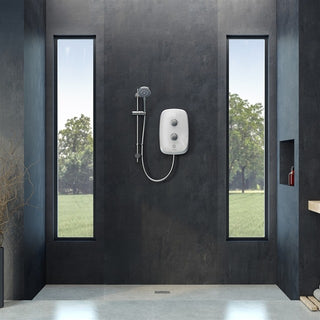
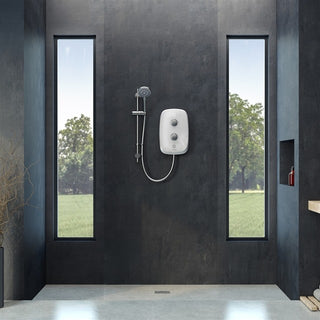
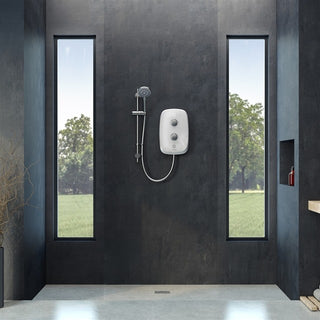
The eVolve comes in white, grey or black with satin silver in all three ratings, and Aqualisa gives a 2 year warranty. It has a digital temperature display, three spray patterns and automatic phased shutdown to reduce limescale. Browse the full Aqualisa showering range for the rest of the family.
If the mains cannot support an electric unit, a mixer is the answer. The shower valves collection covers thermostatic options.
- Mains pressure and flow measured, not guessed
- Winter inlet temperature allowed for
- MCB and cable matched to the datasheet and the run
- Rating chosen from the flow table, not the label
- Colour matched to the room: white, grey or black
- Delivery allowed for: direct from the supplier, usually 3 to 5 working days
FAQs
For most homes a 9.5kW shower is the sensible default. It gives a comfortable flow in winter on a 40A circuit. Go to 10.5kW where the mains flow is strong and the board can carry a 45 or 50A breaker, and drop to 8.5kW only where the supply is limited.
No. Both heat the water to the same temperature. The 10.5kW can heat more water to that temperature, so it holds the flow better in winter. Aqualisa lists 4.30 litres a minute at 37 degrees from 5 degree water for the 10.5kW, against 3.48 for the 8.5kW.
Colder incoming water needs more heat to reach the set temperature. The unit has a fixed power, so it cuts the flow to compensate. On a 9.5kW eVolve the maximum flow falls from 5.69 litres a minute at 15 degrees to 3.89 at 5 degrees at the top power setting.
Aqualisa specifies a 40A MCB for the 8.5kW and 9.5kW eVolve and 45 or 50A for the 10.5kW. Cable size depends on the run and the installation method, so a qualified electrician should size it under BS 7671. Never fit a bigger breaker than the instructions allow.
Aqualisa gives a minimum of 0.85 bar for the eVolve, with 1 bar recommended and a recommended maximum of 3 bar. It needs a mains cold supply, so it will not run from a gravity-fed tank. Measure the flow and pressure at the connection point before you order.
The plumbing is straightforward, but the circuit is not. In England a new circuit is usually notifiable under Part P, so it must be installed by a registered electrician or reported to building control. Approved Document P explains when notification is needed. Wales, Scotland and Northern Ireland have separate rules.
Related reading
Choose your electric shower
Pick the rating from the flow table, match the breaker, then order the Aqualisa eVolve in one go.