Quick answer: A double pole (DP) switch breaks both the live and the neutral conductor at the same time, fully isolating an appliance from the mains. A single pole switch breaks only the live. UK homes run on 230V, so DP isolation is the safer choice for fixed appliances such as cookers, electric showers, boilers and immersion heaters, and it is what BS 7671 expects where you need a local means of isolation.
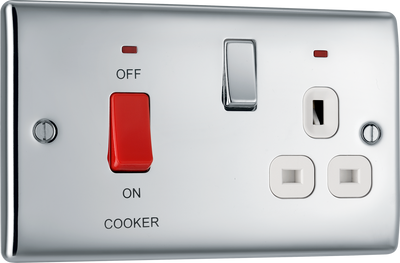
In a UK kitchen you will often see a chunky switch above the worktop with a neon light, marked "COOKER" or "45A". That is a double pole switch. Here is what it does, where the regs want one, and how it differs from the ordinary switches on your walls.
What is a double pole switch?
A double pole switch controls two conductors at once: the live (line) and the neutral. Flip it off and both are broken, so the appliance is completely cut off from the supply.
A single pole switch breaks only the live. The neutral stays connected. For a light or a fan that is fine. For a fixed appliance you are about to service, it is not, because a fault elsewhere on the circuit can still make that neutral live.
Single pole vs double pole at a glance
| Feature | Single pole (SP) | Double pole (DP) |
|---|---|---|
| Breaks live | Yes | Yes |
| Breaks neutral | No | Yes |
| Full isolation | No | Yes |
| Safe for servicing | No | Yes |
| Typical rating | 6A to 20A | 20A, 45A, 50A |
| Typical use | Lights, extractor fans | Cookers, showers, boilers, immersion heaters |
Why the UK uses double pole isolation
UK homes run on a 230V single-phase supply. The neutral is not a dead wire, it is the return path carrying current back to the supply. If a wiring fault or a borrowed neutral puts a voltage on that conductor, a single pole switch leaves it live even when the appliance looks "off". Breaking both conductors removes that risk. That is why DP isolation is the norm for anything fixed and high powered, and why your electrician reaches for it during second fix.
Where double pole switches are used
- Kitchen: 45A DP cooker switches for ovens and hobs; DP fused spurs for fixed under-counter appliances. See cooker switches and sockets.
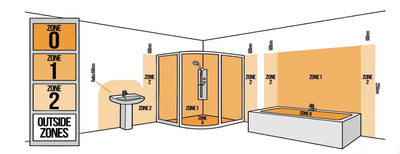
- Bathroom: 45A or 50A DP pull-cord switches for electric showers, sited outside the shower zones (see our BS 7671 bathroom zones guide).
- Airing cupboard: 20A DP switches with neon for immersion heaters, so the element can be isolated for descaling.
- Boiler and heating: a switched fused connection unit (often DP) so the boiler can be isolated for service. See fused connection units and our fused spur vs plug socket guide.
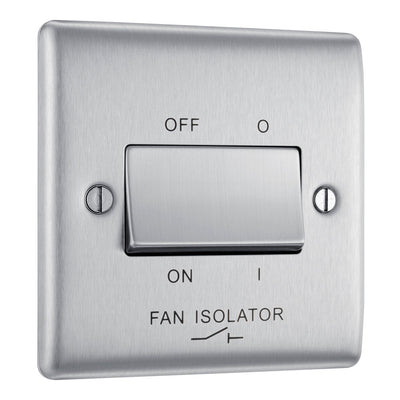
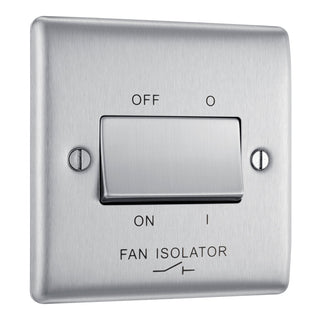
- Extractor fans: a 3-pole (triple pole) fan isolator, the DP idea extended to switch the permanent live as well. See fan isolator switches.
How to spot one on the wall
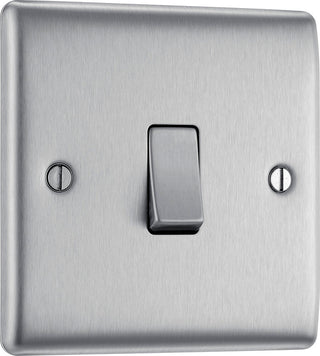
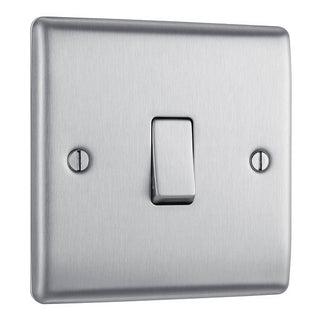
- Bigger plate than an ordinary light switch, often with a wide rocker.
- A neon indicator showing whether power is on.
- Marked "DP", "Double Pole", or rated 20A, 45A or 50A.
- Frequently labelled by appliance (COOKER, SHOWER, WATER HEATER), which is exactly what our custom engraved appliance grid switches are built for.
A note on wiring (leave it to a sparky)
A DP switch has terminals for live in, live out, neutral in and neutral out, plus earth. The supply pair goes to the IN terminals, the appliance pair to the OUT terminals, earth to the earth terminal. Simple in principle, but rating, cable size and isolation testing all have to be right, so this is electrician work under BS 7671, not a DIY swap. If you are renting it out, the inspector checks this at the EICR.
Frequently asked questions
Do I legally need a double pole switch for a cooker?
A cooker needs a local means of isolation, and a 45A DP cooker switch is the standard way to provide it. BS 7671 requires isolation for fixed appliances; the cooker switch satisfies it and lets you kill the hob safely.
What does DP mean on a switch?
DP stands for double pole: the switch breaks both the live and the neutral together, fully isolating the circuit. SP (single pole) breaks the live only.
Can I use a double pole switch instead of a single pole?
Yes, electrically a DP switch works anywhere an SP one does and adds full isolation. It costs a little more and is larger, so most lighting stays single pole while fixed appliances use DP.
What rating double pole switch do I need?
Match the appliance: 20A DP for immersion heaters and many fixed appliances, 45A DP for most cookers and electric showers, 50A DP for high-output showers (10.5kW and above). Your electrician sizes it to the load and cable.
Is a cooker switch the same as a double pole switch?
A cooker switch is a double pole switch, usually rated 45A and often with a neon and a 13A socket built in. The term "cooker switch" just names its job.
Shop double pole switches and isolation
- Cooker switches and sockets — 45A double pole isolation for ovens and hobs
- Fused connection units — switched DP spurs for boilers and fixed appliances
- Fan isolator switches — 3-pole isolation for extractor fans
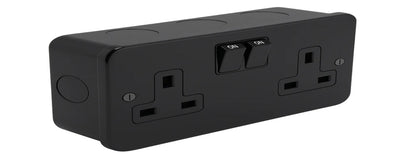
- Double sockets — including DP-switched models
- Custom engraved appliance switches — label every circuit clearly
All genuine British General, UK stock, with trade pricing. Not sure on rating? Read the switches and sockets buying guide or compare BG Nexus and Evolve. Fitting out several rooms? Open a trade account for project pricing. This guide is general information, not a substitute for advice from a qualified electrician.
Shop the range at Kent Traders
Need a double-pole switch for a cooker, water heater or appliance? Browse the options. Browse our UK trade range:
- 45A double-pole cooker switches
- Fan isolator switches (3-pole)
- Light & plate switches
- BG Nexus & Evolve ranges