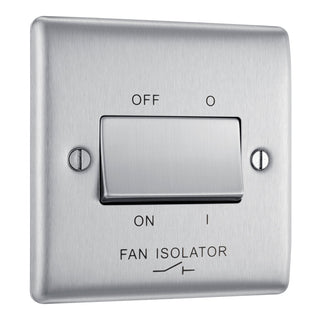
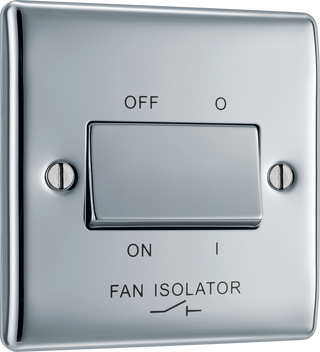
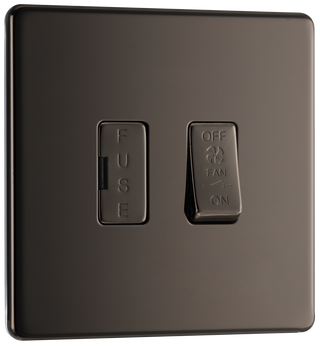
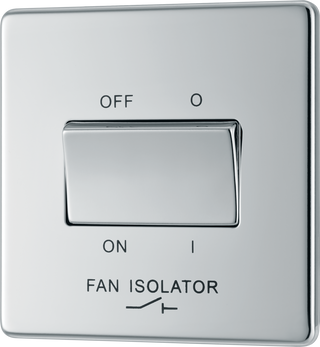
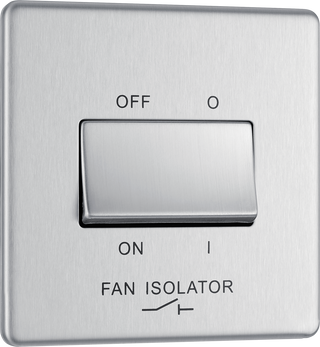
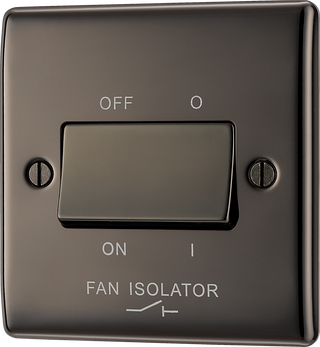
A fan isolator switch is a small, dedicated switch that lets you completely cut power to an extractor fan. It is a BS 7671 best-practice fitting for bathroom and kitchen fans, and essential for timer or humidity-sensing models.
Why 3-pole, not 1-pole?
Simple on/off fans switch a single live. But timer, overrun and PIR fans have a permanent live feed as well as a switched live. A 1-pole isolator would leave that permanent live connected. A 3-pole isolator breaks live, switched live and neutral together, so the fan is genuinely dead for maintenance.
| Fan type | Isolator needed |
|---|---|
| Basic on/off (with light) | 3-pole recommended for safe isolation |
| Timer / overrun | 3-pole required (permanent live present) |
| Humidity / PIR sensing | 3-pole required |
Where should the isolator go?
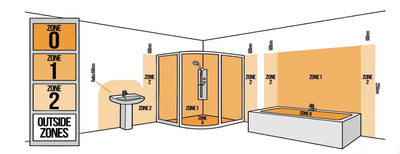
Site the isolator where it is accessible but outside the bathroom zones, commonly just outside the bathroom door or in the loft space near the fan. Keep it out of zones 0, 1 and 2 unless suitably rated. Your electrician will confirm placement under BS 7671.
Installation
Wiring a fan isolator is fixed electrical work and should be carried out by a qualified electrician. You can select and buy the isolator and have it fitted alongside the fan.
FAQs
Do I need a fan isolator switch? It is strongly recommended for any extractor fan and required in practice for timer/overrun/PIR fans so the permanent live can be isolated.
1-pole or 3-pole? Use 3-pole. It isolates the permanent live that timer and overrun fans carry; a 1-pole leaves it connected.
Where do I fit it? Accessible but outside the bathroom zones, typically just outside the door or near the fan in the loft.
Can I fit it myself? No, it is fixed-wiring work; use a qualified electrician.
What rating? A 10A 3-pole fan isolator suits standard domestic extractor fans.
Shop the range at Kent Traders
Fitting a bathroom or kitchen extractor? We stock 3-pole fan isolator switches from BG and leading UK brands. Browse our UK trade range:
Shop fan isolators